Showing posts with label Railways. Show all posts

Tuesday, 22 May 2018

Give us the money?

The Welsh Affairs Committee at Westminster told us yesterday that the UK Government had saved at least £430 million by not electrifying the railway line between Cardiff and Swansea, and suggested that the whole of the money saved should be made available for other transport schemes in Wales.  I’ve got a better idea: if the whole of the money saved by not electrifying the line is available for spending on transport schemes in Wales, why don’t we spend it on electrifying the line between Cardiff and Swansea?  Because, at its simplest, if the cash is available, why not spend it as originally planned?
It wasn’t a lack of money which, allegedly, drove the decision to cancel this part of the electrification project, but an analysis of the cost-benefit ratio, which concluded that the scheme was not good value for money, using the criteria laid down by the government itself.  But whether those criteria are valid or not is ultimately a question of judgement.  They are based, broadly, on a comparison between the cost of doing the work and the value of the time saved by passengers; but given the well-known problems of the railway line west of Cardiff, the time savings were always going to be minimal for that section of track.  It’s much harder to put hard cash values on other benefits of the scheme, such as increased reliability and reduced environmental costs - both from moving away from diesel and attracting more traffic from the roads.
However, the idea that money, once allocated to a scheme in Wales, should be available for other schemes in Wales if the original scheme is cancelled is one with which I’m hardly going to disagree.  The logic of that, though, is that the money and the responsibility should have been allocated to Wales in the first place.  Then we could have decided whether to electrify or not.  The strangest part of all in the story from Westminster is that the man demanding the money comes to Wales anyway is historically one of those most opposed to devolving extra responsibilities to Wales.  Still, he’s a Tory – logic and consistency are not to be expected.

Friday, 21 July 2017

Swansea isn't the end of the line

A promise by a politician is rarely worth the paper on which it often isn’t even written, and there is no reason why a promise to electrify a railway should be any different.  Breaking the promise to electrify the line to Swansea will not exactly enhance the reputation of those who’ve done it, but in all fairness, they are currently hard at work breaking much bigger promises than that one.
I’d give them almost full marks for inventiveness in selling this as an advantage because we won’t have the disruption of all the engineering works in carrying out the upgrade, but I do wonder where that line of argument will lead.  It could easily become an argument for not doing a lot of other things.  There is, after all, quite a lot of disruption involved in building hospitals, schools, roads …
They are right in arguing that it will give us better more modern rolling stock with more seats more rapidly than waiting for electrification all the way to Swansea with electric-only trains, and they’re also right in arguing that it won’t make any difference to journey times between Cardiff and Swansea because the restriction there is the track, not the source of power or the rolling stock.  That does, though, rather gloss over the fact that the new trains will be heavier, more expensive to buy and run, and less environmentally friendly than the all-electric ones we could have had if the project had gone ahead.  I’m not particularly convinced either about some of the arguments put forward about this being a huge blow to the image of Swansea in trying to attract investment.  I would have thought that the quality and reliability of the transportation would be more important than the source of power.
There is another advantage (in the sense of it being an ill-wind which has none) to the decision taken yesterday which few seem to have even realised let alone commented on, and that is its impact on those of us who live even further west of Swansea (although I entirely understand that people in London might not be fully aware of our existence).  That advantage is that bi-modal trains don’t have to terminate their journey at Swansea; like the existing aged beasts they will be perfectly capable of travelling past the end of what seems to be regarded as civilised Wales and out into the sticks where some of us insist on residing. 
One of my concerns from the outset has been that the electrification project would take away the few through trains which we currently enjoy.  As a short term expedient that might have been something up with which we might have had to put, but the problem with the electrification project has long been that it has been seen as a single one-off project rather than part of a longer term vision to electrify the whole network.  We still need that longer term vision of an all-electric railway; all that’s really changed is that the section of line from Cardiff to Swansea has been added to that part of the network for which that vision is required.  I hope that those who so far seem to be mostly interested in making political capital out of the decision will also take that on board and not restrict their arguments to one short stretch of line.

Thursday, 31 July 2014

Cardiff, Cardiff, Cardiff...

The plans for the revamp of Cardiff Central station are ambitious.  They are also likely to be very expensive.  It’s not a plan that I’d oppose in principle, but I don’t agree that it should be the next priority for the network rail investment programme.
I understood why electrifying the main line from Paddington to Swansea should be a top priority.  I can also understand why the lines running through the South Wales valley should be the second priority.  But there are still unelectrified lines in west and north of Wales, and I cannot understand why the scheme to electrify those is not being brought forward ahead of the revamp of Cardiff station.
I try to avoid falling prey to simplistic regional jealousies pitting one part of Wales gets another.  And given the concentration of population and employment in the south-east, the status of Cardiff as the capital, I can understand the logic of an electrification scheme which serves that area first.  It shouldn’t end there though, and a desire to avoid internal competition shouldn’t become an abject acceptance that all investment goes to one corner.
The comment made by the Institute of Directors (“If Cardiff is to compete with other cities in the UK and internationally for investment, then it really needs a train station that is as good as anything else”) sounded like a reprise of why we have to build the extra M4 around Newport, why we have to create a city region based on Cardiff, and why we have to build the Greater Cardiff Metro.  How many more things does Cardiff “need” because we will not get economic development without them, and when will Cardiff have ‘enough’ grand schemes to allow serious investment elsewhere in Wales?
It increasingly looks as though the answer is never – no sooner has one key problem been overcome then another one gets pushed to the fore.  There will always be another key obstacle to Cardiff's development which the rest of Wales will have to pay for, as funds are directed to that one corner of the country.
It’s hard to deny that Cardiff is receiving a substantial devolution dividend, but what about the rest of Wales?  Replicating the south-east bias of the UK was never anyone’s stated intention – yet that’s where we seem to be going.

Tuesday, 9 April 2013

Unpicking the legacy


I’m a regular user of the railway between Carmarthen and Swansea.  But for the last two weeks I’ve been unable to use that rail service due to work taking place to redouble the track at Gowerton.  (MH at Syniadau has a nice picture of the new bridge here).  Today, for the first time, I’m back on the railway using the new bridge and track.  The timing is somehow appropriate.

It was in 1986 in an act of short-sighted vandalism that the government of the day decided to rip up the other track on that particular route.  I’m pretty certain that Margaret Thatcher never actually did say the words attributed to her in 1986 namely “A man who, beyond the age of 26, finds himself on a bus can count himself as a failure”, but it was certainly a reflection of the attitude of the government of the day towards public transport .

It is easy though, far too easy in fact, to blame one individual for taking particular decisions that we don’t like.  It seems to me that the real “triumph” of Margaret Thatcher, if such it can be called, was not so much in what she and her government did, but in the shift in the political climate which they brought about.  The wholesale adoption of many of the Thatcher government’s policies by Tony Blair and the rest of new Labour's 'modernisers' in the pursuit of power ensured that her legacy long outlasted her reign.

It has taken 27 years to unpick one small part of the legacy of that particular era.  How much more there is still to do. 

Friday, 25 May 2012

It's all one railway line

In saying that there must be a ‘business case’ for extending electrification to Swansea this week, the Secretary of State has not really said anything new.  The question needs to be asked however – how long does it take to produce one, and why hasn’t it been done yet?  After all, they’ve been in power for two years now, and as I recall, there have been some sort of figures produced before.  Does it really take two years just to review and update work done previously?
Personally, I’m not a huge fan of the vogue for producing ‘business cases’ in any event.  There’s nothing wrong with the concept, but as someone who’s produced more than a few of them over the years, I’m well aware that they have more to do with justifying why the preferred option is the right one than with an objective analysis of the options.  I wouldn’t say that creative writing is the most important skill in drawing up such a document, but it’s up there somewhere.
Figures in themselves are an important part of any story; but they rarely tell the whole story.  And many figures are the result of estimates, which themselves depend on assumptions, which in turn depend on prejudices and preconceptions.  In this case, it seems to me that the government is using the current absence of a business case as a fig leaf behind which to hide whilst they continue to delay.
Another way in which the use of business cases can be used to obfuscate rather than clarify is in the definition of a project.  In the case of rail electrification, the requirement to produce a separate case for Cardiff -Swansea electrification will produce a different answer than if that section were included in a single case for the whole route from Paddington – Swansea.  So the person who decides where to draw the line between projects has a great deal of influence on the final outcome.
It might be argued that splitting the project up into a number of smaller sections is a valid way of determining which bits are or are not viable, but to take that to extremes, a mile by mile analysis would almost certainly conclude that no individual mile was worth electrifying.  And even if the route is split more rationally into station-station sections, the viability of each section will also to an extent depend on what decision is taken in regard to other sections.
The real decision which Gillan and the Government need to justify is the arbitrary one they took to electrify only part of a major route in the first place.  There is a difference between seeing individual projects as part of a wider project to electrify the whole system and seeing it as just a series of projects each of which must be individually justified, and the latter seems to be the view of the government.  It’s a short-sighted way of looking at the question.

Thursday, 15 March 2012

Wrong priorities

The announcements by the UK Government last week about rail finances serve only to confirm a lack of real commitment to public transport.  Faced with a demand which exceeds the supply at peak hours, their response seems to be the classic piece of economics – increase the price until the demand drops to match the supply.
There is scope, of course, to stagger the peak hours more effectively by encouraging companies to work more flexibly, and that would make better overall use of resources.  I doubt, however, whether upping the price of peak hour public transport is going to be the most effective or efficient mechanism to achieve that.
Pricing people off the railways will only increase roads congestion, and lead to yet more calls for more road-building.  What is actually needed is a plan to increase rail capacity, in order to reward and encourage the growing trend to the use of public transport, but they seem unwilling even to consider that.
Comparisons with the cost levels of railways in other countries may be interesting; but in themselves, I’m not convinced that they tell us much, since the circumstances are so different.  In any large organisation, there will always be some degree of inefficiency and therefore scope for doing things better, but it seems like the wrong thing to be putting centre stage at a time when we really need a cohesive plan for investment and improvement.
So, certainly there are smarter ways of handling ticketing in an increasingly computerised system, and it would seem sensible to pursue those; but we shouldn’t be waiting to drive out cost before we look at how we expand and improve the service.

Wednesday, 22 February 2012

Resurrect the WDA?

I wonder what the reaction would be if the Assembly set up a committee to look into the war in Afghanistan, and then, when it published its report, criticised William Hague for declining to attend to give evidence.  Actually, I don’t wonder at all – I’ve got a pretty good idea what the reaction would be.
But how different is it really from a position where a committee of the House of Commons decides to look at a devolved issue – economic development – and then criticises the minister responsible for not agreeing to be grilled by the MPs?
I can understand the irritation in Cardiff at the uninvited interference.  I hope, though, that such natural and justifiable irritation will not lead to a too hasty rejection of the report.  The fact that much of what the MPs have to say is none of their business doesn’t mean that they aren’t making some very valid points.
Their call for the UK Government to extend electrification of the railways – a matter for which they still have responsibility – to Swansea and the Valleys lines is one with which many of us would agree, although I’d like them to have gone further and declared that those were merely the next two steps on a programme to electrify the entire network in Wales.  There is life west of Swansea.
Their message about the loss of the WDA echoes what many in Wales have been saying for some years.  It was a mistake at the time – both for the Government of the day and for the main opposition at the time in supporting it, as Elin Jones recently highlighted.  And there were plenty of people saying at the time that it was a mistake.
I never understood why the baby – the WDA – was being thrown out with the bathwater – the system of appointed members of the great and the good to run quangos.  The latter could have been done without carving the WDA up and incorporating it into the civil service.  Getting back the ethos and culture of that body will not be easy at this stage, but it’s disappointing to see such a lack of will to try.

Tuesday, 12 July 2011

Fewer new roads?

There was a lengthy story in yesterday’s Western Mail about the transport experts calling for a review of all road schemes in Wales in the light of evidence that car traffic might be declining.  One thing that struck me as notable in the report was that – unusually – there was no comment from politicians of any party.  Whether they were asked and declined, or simply not asked, I don’t know. 
There are few topics on which politicians are usually reticent to rush out a quote.  Road-building may well be one of them; it’s a subject on which they know that they can’t please everyone.
In another context, it became clear to me a week or two ago that much of the economic case put forward by governments for road schemes is based on an assumption that traffic will continue to grow inexorably.  Partly this is just a result of population growth, but it’s also partly based on the assumptions that there will be economic growth, and that economic growth will of necessity lead to increased traffic.
It’s good to see those assumptions – all of them – being challenged. 
I wouldn’t support the abandonment of all the proposed road schemes though.  Although governments like to present the case in business terms, as though everything can be reduced to cost and benefit, there are other factors involved of which we should not lose sight.  Not a few of our trunk roads follow very old routes through the centres of villages and towns, and even if the levels of traffic drop from current levels, there are still valid reasons for constructing some alternative routes.
But overall, a stress on alternatives to road-building is to be welcomed, particularly if it starts to look more at freight traffic as well as passenger traffic.  Although there has been a switch in recent years from investment in roads to investment in public transport, it’s been too little too slowly.
Rail improvements are still too often the result of responding to lengthy campaigns after the demand has already appeared rather than an attempt to plan and provide pro-actively to encourage the demand.  Similarly the freight strategy for Wales is a document full of worthy sentiments, but remarkably light on hard actions which will do other than respond to demand.
The response of the Welsh Government to the report was not encouraging.  They clearly remain wedded to the idea of continuing growth in road usage.  It’s another example of a mismatch between 'green' words and 'business as usual' actions.

Wednesday, 2 March 2011

Longer term view needed

Clearly, the electrification of the main line to Cardiff is good news.  But the decision not to continue on to Swansea is bad news for those of us in West Wales.  And the worst news of all (despite apologists for the current UK coalition government trying to claim it as good news) is the decision to go ahead with hybrid rolling stock, having both electric and diesel power.
I understand why clutching at the straw of not having to change trains at Cardiff may appear to be good news, but the choice of hybrid rolling stock has two major disadvantages, in my view.  The first is that it undermines many of the advantages of electric stock – it reduces the cost savings, the extra weight undermines the reduction in wear and tear on the line itself, and the extra complexity means that it loses the advantages of improved reliability and reduced maintenance costs which accompany the move to electric power.
But it is the second disadvantage which concerns me more.  That is that this is inherently a decision with long term consequences.  The new rolling stock is likely to have at least a forty year lifespan, and that reduces the incentive for extension of electrification to Swansea and beyond at an early future date. 
Although it would obviously be preferable to have made the decision on the whole line to Swansea now, the electrification project has such a lengthy timescale that that there is still a window of several years to enable the project to be extended, without incurring the extra costs of a whole new and separate project.  And the environmental, reliability, and cost advantages of electric power are such that I, even as a resident of West Wales, would have preferred to put up with a (comparatively, when looking at a 40 years lifespan) short term change of train at Cardiff in the hope of getting that extension.
The underlying problem is that this government, like its predecessor, is taking decisions on a case by case basis, rather than having a master plan for electrification of the whole network, which is where any government which is serious about reducing the environmental impact of transport would start.
I’m not entirely sure what to make of the announcement of a willingness to look at a comprehensive electrification of the Valleys.  It’s a bit of a mixed blessing, I fear. 
On the one hand, it is clearly a significant investment in transport infrastructure and emissions reduction in a heavily trafficked part of Wales’ rail network, and that has to be welcomed.  On the other hand – and I accept that this is very much said from a West Wales perspective – it emphasises once again a Cardiff-centric approach.
This again underlines the piecemeal approach being taken – if it were just the next step in an overall programme to electrify the whole network, I might grumble a bit about why it has to start in Cardiff, but I’d have to accept that there would be a certain logic to that.  But as a step on its own with no promise of follow-up, coupled with the limitation on the main-line announcement, those of us in the West can surely be forgiven for feeling that we are being left behind with a second class rail network.
And this is more than just a question of transport infrastructure.  It sometimes looks as though the UK policy of development concentrated in the South East whilst the rest is left behind – a policy which has been so damaging to Wales over the decades – is being repeated on a smaller scale in Wales.  I’ve commented before on the apparent emphasis in the Economic Renewal Plan on developing the major conurbation around Cardiff as a significant economic driver.  Concentrating investment in transport infrastructure on that area will serve only to reinforce that trend.

Thursday, 25 November 2010

Carts and Horses

The decision by the UK Government to put the electrification of the line to Swansea ‘on hold’ is hugely disappointing.  The Government’s argument that “it needs to decide whether to replace the intercity fleet with electric trains, or electric-diesel hybrids beforehand” looks like a classic case of putting the cart before the horse.
The fact that the rolling stock needs replacement is not new, nor is it a surprise.  Part of the justification for doing the electrification as early as possible should surely have been to enable the purchase of electric rolling stock, which would be faster, cheaper, more reliable, and environmentally preferable.  Taking the decision as to which trains to buy first looks like committing us to another 40 years of diesel operation.
Having said that, I’m not convinced about the sincerity of Labour’s response either.  It is increasingly clear that the ‘immediate’ start to preparatory work promised by Gordon Brown never actually happened, and in that context, it is hard to argue that his announcement was not a rather cynical pre-election ploy.
And, hand on heart, how many can people honestly and truly say that they are convinced that a CSR undertaken by a Labour Government would not have reached a similar conclusion?  After all, the difference in the total level of cuts proposed wasn’t that great.

Wednesday, 24 November 2010

Time to stop pretending

In the latter days of the Soviet Union, it was said that "the workers pretend to work, and we pretend to pay them".  It was quite a neat summary of the state which the economy had reached.  But pretence about the true nature of things isn't limited to the old Soviet Union.

Closer to home, we have, since the days of the Thatcher government, pretended that the railways are operated as profit-making companies in the private sector.  So Arriva Trains Wales receives something like £165 million a year from the public purse towards the cost of running its services, and pays out around £10 million a year in dividends to its shareholders as a reward for their 'profitable' investment.  It's nonsense, of course; the truth is that the services are effectively making a loss of £155 million per year; and not only are we as taxpayers making good that loss, we are also bunging the shareholders a £10 million bonus as well.  And under the sort of 'not-for-profit' proposal announced by Plaid recently, that pretence would end, and that extra £10 million would potentially be available for further rail investment.

It's been announced this week that fares are to rise by an above-inflation amount in the New Year, and I heard a spokesman for ATOC explaining this in a radio interview yesterday.  One of the points that he made was that this is a result of long term government policy to shift the balance of paying for rail services from the taxpayer to the rail user.  That isn't a policy which has been introduced since May this year, nor is it a response to the recession.

The idea that a service should be paid for by the users of that service is a valid viewpoint - it's the principle generally applied to private sector services.  It isn't the principle applied in general to public sector services, however (although successive governments have tried to move things more in that direction).  More specifically, it isn't the principle used for the main competitor to rail, namely road transport.  Trying to run railways as though they are a profitable enterprise is something which most of the rest of the world has eschewed - and with good reason.  We should stop pretending, too.

Friday, 29 October 2010

Electrification - let's get on with it

My initial reaction when I read the part of today's story about the electrification of the mainline was a degree of outrage at the idea that the UK Government would ask the Assembly Government to pay part of the costs.  But then I asked myself whether this expenditure is Barnettised or not - and I have to admit that I don't actually know the answer to that.  If this is additional UK expenditure, over and above the existing transport budget, then the reaction stands; but if the expenditure is coming out of the English transport budget for which Wales has already had, or will be receiving, a Barnett share, then it it not entirely unreasonable for the UK Government to start talking to the Welsh Government about a contribution.

What is absolutely clear, though, is that asking the Welsh Government to pay a proportion is not a way of delivering the project for "less than the £1bn initially estimated", which seems to be the UK Government's starting point.  Paying out of different pots is simply not the same thing as reducing the cost - and disingenuous is an understatement for the suggestion that it is.

I'm clear that there is a good case for electrification - greater reliability, lower maintenance costs, less pollution.  It helps meet emissions targets (depending on how the electricity is generated), and it helps the switch from road to rail.  And there's a good case for the timing; with the rolling stock needing replacement in the next few years, failure to electrify now condemns us to another 40 years of diesel powered railways.  Electrifying the whole railway network as rapidly as possible is something which deserves support.

I'm not entirely convinced that 20 minutes off the journey time makes as much difference as some seem to suggest.  Certainly I, like most other people, like to get from A to B as rapidly as possible, but when I was travelling fairly regularly from South Wales to London it was the lack of certainty about the arrival time which was much more of a concern to me.  Having to catch a train an hour earlier 'just in case' is a real deterrent.

And I'd like to see research which indicates that this will have the massive impact on economic growth which some seem to imply - particularly if the Welsh Government is serious about switching its economic strategy to development of indigenous companies.  I'm not suggesting that it won't have an impact, merely that the impact may have been somewhat exaggerated.

And we simply don't need to exaggerate or play the victim; the project stands up without that.

Wednesday, 22 September 2010

Back to the future

Conservative-leaning think tank, the Policy Exchange, have published some proposals for railways in the UK. They claim to be looking to the future - what I read was a series of unfortunate echoes of the past, most particularly the Beeching era.

The problem with their proposals is that they’re starting from what is, for me, completely the wrong place. Their basic premise seems to be that the railways are a drain on the public purse which needs to be stemmed, whereas I start from the premise that a switch to rail travel is something to be encouraged on environmental grounds.

Do we want to reduce capacity so as to service only commercially-viable demand, or do we want to add to capacity and stimulate demand? The first approach leads to a switch from rail to road, the second encourages a switch in the opposite direction.

Because they are starting from economics, rather than transport or environmental policy, some of their recommendations look positively perverse to me. For instance, heavier and faster trains cause more wear on the track, so if we use shorter and slower trains, track maintenance costs can be reduced. Another is to allow train companies to run fewer services, or stop at fewer stations if by so doing they can reduce their costs by only carrying the most profitable passengers.

Services from Aberystwyth are amongst those specifically mentioned by them as being ones where "niche operators may be willing to fill the gap..."; but if no-one wants to run such services without subsidy, then 'local people' should be free to decide what happens. "They can have a rail service, with the subsidy paid for locally, or they can choose to keep their cash and the line closes". It is a recipe for undoing the work of the last 20 years to rebuild rail services and encourage people out of their cars – and for removing rail services from much of Wales.

I wouldn’t argue that we should be running empty, or near empty, trains ‘just because’; and the report does make some sensible suggestions about flexibility in franchising and the disincentives that can exist within the franchising approach. But we do need to think about what we want the railway system to achieve – and profitability is not at the top of my list.

The report makes what I consider to be a wholly invalid comparison between the railways and low-cost air services, claiming that those air services "separate the essentials from the nice to have", and yet "still offer a product that people want to use". And that really sums up the huge difference between the approach that they adopt and the approach I think we should be adopting.

The railway system shouldn’t be seen as simply a commercial exercise in responding in the cheapest possible way to a demand for rail travel; it should be seen as something that we positively encourage people to use as an alternative to other forms of travel. And that means that we deliberately need to make it more attractive than the alternatives, not reduce it to the same level.

Attempting to run the railways as an entirely commercial operation was what led to the loss of so much of our rail infrastructure in the past. It’s a step backwards which we should reject.

Wednesday, 31 March 2010

Getting Pembrokeshire back on track

This week's announcement of the Wales Transport Plan by Ieuan Wyn Jones contained much that is good and should be welcomed. At a strategic level, I am convinced that transport policy in Wales is starting to move in the right direction, with the emphasis switching from road building to improving public transport.

That's not to say that I'm entirely happy with it though, and there is one issue which jumped out at me. The plan continues to argue that the 5 mile stretch of single rail track between Gower and Loughor is a major pinch-point, and that it restricts the potential growth of passenger traffic to the west of Swansea.

This is, to put it bluntly, simply not true. There is no reason at all why services should not run along the alternative, already dualled, Swansea District Line, which effectively bypasses Neath and Swansea, as well as bypassing the single track section of line in question. Indeed, a small number of services already do use this line. Working with our colleagues in Preseli-Pembrokeshire constituency, we put together a clear and comprehensive case for the use of that line, and refuted totally the argument that there is any dependency on the Gowerton line.


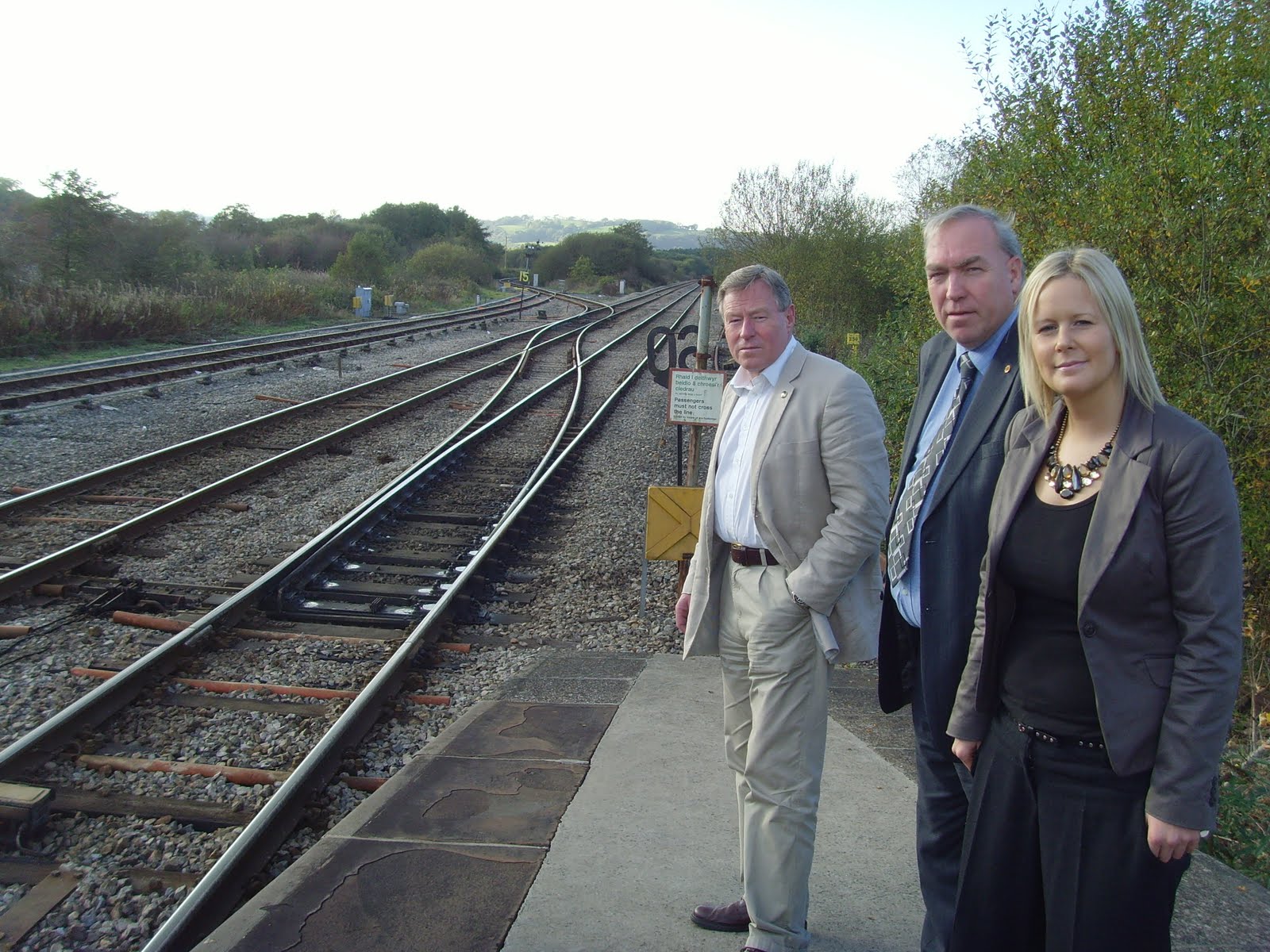
Services to Llanelli and Carmarthen, and more especially to Pembrokeshire, which receives a much less frequent service from Whitland (where the line splits, as shown in the picture) onwards could be increased significantly with no investment at all in track – the investment we need is in rolling stock. The real dependency is not on the single line stretch, but on the insistence of government and train operators that all trains to West Wales need to stop at Swansea. That is, of course, a completely different argument.

It's not an argument that convinces me, however. We did not propose any reduction whatsoever in the services to and from Swansea – what we proposed were extra services to the far west which simply bypass Swansea completely. Longer term, there's the potential for another Swansea station on that alternative route – a parkway station at the M4 service would be ideal – but for people travelling between West Wales and Cardiff, say (or further east), those extra services could be easily introduced now.

This is an issue where we locally will not accept the conclusion of the plan – we will continue to campaign and pressurise for a better rail service for Pembrokeshire.