Showing posts with label Assembly Government. Show all posts

Wednesday, 2 June 2010

Strategy and implementation

I've been reading the Welsh Government's strategy for Welsh-medium education. Like most of the government's strategies, it's full of fine-sounding words. How about this, for instance: "We therefore expect local authorities in which there is a choice between Welsh-medium and English-medium provision to identify how they will provide sufficient and appropriate places for children whose parents/ carers desire then to have Welsh-medium education".

I can't find any clause which excludes Carmarthenshire from this requirement, although they have clearly been excluded from it by the government. Nor can I find the clause which says: "and after you've been working on the plans for two years with our full knowledge, we can then reject them on a whim", although such a clause clearly applies in the case of Cardiff.

I was glad to see that they do recognise that the term 'bilingual provision' is used to mean a wide range of different sorts of provision. Looked at in detail, the range is so wide as to make the term pretty much meaningless in practice. The killer line in what they have to say on 'bilingual settings' is that "Bilingual provision, therefore, does not always ensure that an individual becomes a bilingual speaker".

It's true, if something of an understatement – the reality is that 'bilingual provision' as seen in much of Wales hardly ever results in a child who was not already fluent in Welsh becoming a fluent speaker of the language. But it's a fact about 'bilingual provision' which authorities are rarely willing to spell out to parents. If they did, the demand for true Welsh-medium education would likely increase further.

Their strategy requires education authorities to factor in 'the additional demand which often appears when a new and convenient Welsh-medium school is opened'. But that's a meaningless exhortation if authorities are simply allowed to ignore the base demand in the first place.

As with so many government 'strategies', I was left with the impression that the production of a strategy is seen as an end in itself, rather than a basis for implementing meaningful change. I'd be delighted to be proved wrong, but I won't hold my breath.

Wednesday, 31 March 2010

Getting Pembrokeshire back on track

This week's announcement of the Wales Transport Plan by Ieuan Wyn Jones contained much that is good and should be welcomed. At a strategic level, I am convinced that transport policy in Wales is starting to move in the right direction, with the emphasis switching from road building to improving public transport.

That's not to say that I'm entirely happy with it though, and there is one issue which jumped out at me. The plan continues to argue that the 5 mile stretch of single rail track between Gower and Loughor is a major pinch-point, and that it restricts the potential growth of passenger traffic to the west of Swansea.

This is, to put it bluntly, simply not true. There is no reason at all why services should not run along the alternative, already dualled, Swansea District Line, which effectively bypasses Neath and Swansea, as well as bypassing the single track section of line in question. Indeed, a small number of services already do use this line. Working with our colleagues in Preseli-Pembrokeshire constituency, we put together a clear and comprehensive case for the use of that line, and refuted totally the argument that there is any dependency on the Gowerton line.


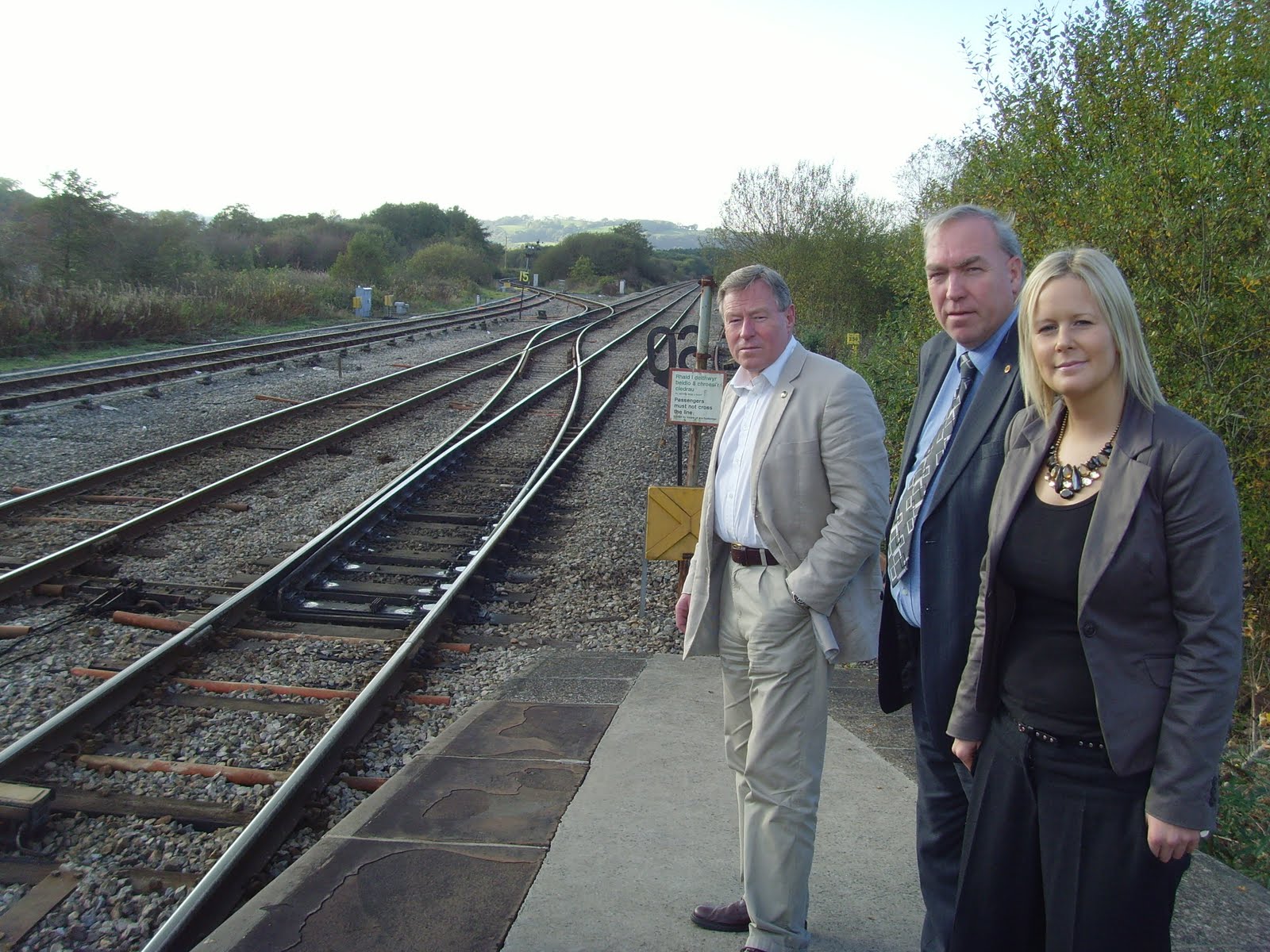
Services to Llanelli and Carmarthen, and more especially to Pembrokeshire, which receives a much less frequent service from Whitland (where the line splits, as shown in the picture) onwards could be increased significantly with no investment at all in track – the investment we need is in rolling stock. The real dependency is not on the single line stretch, but on the insistence of government and train operators that all trains to West Wales need to stop at Swansea. That is, of course, a completely different argument.

It's not an argument that convinces me, however. We did not propose any reduction whatsoever in the services to and from Swansea – what we proposed were extra services to the far west which simply bypass Swansea completely. Longer term, there's the potential for another Swansea station on that alternative route – a parkway station at the M4 service would be ideal – but for people travelling between West Wales and Cardiff, say (or further east), those extra services could be easily introduced now.

This is an issue where we locally will not accept the conclusion of the plan – we will continue to campaign and pressurise for a better rail service for Pembrokeshire.

Tuesday, 23 March 2010

Power clawback?

I'm not entirely sure what to make of the article by Darren Millar on WalesHome today. Is it a statement of opinion by one individual Tory AM - or is it clarifying and adding detail to the statement made by Cameron - which would make it a great deal more sinister?

The basic analysis – i.e. that a government which has responsibility for the spending side of the balance sheet but not for the income side has no real incentive to wealth creation – is one that I can understand, even if not entirely agree with.

It assumes that governments will only work for wealth creation if they are directly incentivised to do so, rather ignoring the possibility that some politicians might actually do so because they believe it to be right for Wales. I can forgive him that to an extent – most Tories seem to have an inbuilt belief that people will only do what they are incentivised to do. That's one of the fault lines between the political right and the political left.

What is a good deal less clear – and I'm not entirely sure that this isn't deliberate – is what solution is being proposed. The obvious solution would be to give the Assembly Government at least a degree of control over the income side as well. It seems increasingly likely that Holtham will recommend something along those lines, given the report of the Calnan Commission.

Yet Darren Millar ("This is not the same as advocating Assembly powers for raising taxes") seems to be specifically ruling out that option. So what actually is he suggesting? A funding formula which includes "elements which provide incentives for wealth creation" sounds to me like a conditional funding arrangement under which the Treasury only passes money across to Wales if the Assembly Government achieves a set of targets set by London. And that in turn sounds like a major clawback of power from Cardiff to London.

That brings me back to my opening question. If this is just a statement of opinion by one individual Tory about the nature of the relationship between Cardiff and London, then it's no real surprise. I'm sure that it's in line with what many Tories believe - Cardiff needs to be reined in. But if it's a clarification and amplification of what Cameron meant when he agreed that the funding formula needs to be looked at, then it takes on a much more sinister meaning.

Monday, 22 March 2010

Faster action is possible

Last week's figures for the jobless numbers in Wales led to criticism of the Welsh Government by its political opponents. I suppose that's inevitable. To some extent, supporters of the government may have almost invited such a response by some over-enthusiastic cheer-leading for the government's Pro-Act and Re-Act schemes earlier in the recession.

We really need a calmer and more balanced assessment of the situation than using monthly numbers of jobless totals for political point-scoring – in either direction.

People start with an expectation that governments have more influence over the economic situation than is actually the case, and when things are going well, governments encourage this expectation by claiming credit for anything and everything. They should not be surprised if they then find it hard to convince people that 'it's nothing to do with me, guv' when things are not going so well. The truth lies somewhere in between.

As an example, I don't think it's fair to argue that Labour are entirely responsible for the economic catastrophe which hit us after the banking scandal (they can't really be blamed for sub-prime lending in the USA, nor for the short-selling of bank stocks, for instance). But neither can they escape all blame, given that they allowed the markets to do these things with no attempt at regulation as long as they were raking in the taxes, and were building up an excessive deficit even before the bail-outs.

Closer to home, the Assembly government cannot really be entirely blamed for the continuing job losses in the Welsh economy as the recession continues to impact on us. But neither can they entirely escape all responsibility for what is happening in the Welsh economy. (And it's really unhelpful for people to try and argue that the economic situation in Wales shows that 'the Assembly' is a failure, and should therefore be scrapped. This is an issue for government, not the legislature.)

I happen to think that Pro-Act and Re-Act have been a little over-hyped; but that doesn't mean that they were the wrong thing to do. In fact, coupled with the series of 'economic summits' convened by Ieuan Wyn Jones, they showed that a Welsh Government has the capacity to respond quickly and innovatively to situations which arise, and that's an important foundation on which we can build for the future. The approach also earned plaudits from those involved, and a degree of envy from some over the border. As a nation, we're sometimes too quick to see the negative, and ignore the positive.

How much difference the schemes have actually made is something which I hope will be the subject of a proper study in due course – it's too soon to give a final judgement at this stage. Some of the grants made, particularly to larger companies, look a little strange to me; but I do not doubt that there are a number of smaller companies in particular which have been enabled to keep people on at a time when they would otherwise have had to shed workers.

The real question revolves around what else the Government could and should have done - bearing in mind the limitations placed upon it in terms of both finance and powers. It's easy for political opponents to criticise, but where are the constructive alternatives? What would they have done differently?

For my part, I don't think that the government have gone far enough in looking at business taxation – they've certainly not gone as far as Plaid argued that they should in our 2007 manifesto. They don't have the power to cut Corporation Tax, but I do believe that they could and should have done more on the business rates issue, whilst recognising that that would inevitably have had implications for other spending commitments.

The refocusing of economic development activity away from inward investment and onto growing indigenous SMEs is happening, but it's overdue, and happening too slowly for my liking. It seems to me that the biggest problem is a cultural one – too many strategies and too much consultation rather than getting on with it. A harsh criticism perhaps, but one which I would equally make of the UK government in the same context. What we've not yet learned to do is to fully capitalise on the opportunities that devolution gave us to be more fleet of foot and more flexible.

Wednesday, 17 March 2010

Energy Statement

When the Assembly Government published its Green Jobs Strategy, I noted that it was a good strategy, but did not fill me with much confidence that it would actually achieve the objectives. My main reason for saying that was the document was full of words like 'promote', 'support', 'encourage', and 'facilitate'.

Reading the same government's 'Energy Policy Statement' yesterday filled me with a sense of déjà vu. Once again, we have a document full of very worthy and supportable aspirations, but the firm proposals for implementing them are likely to prove inadequate.

The idea of being able to meet the whole of our energy needs from renewable sources within 10 to 15 years is a challenging target, but one which we should certainly adopt. The question is, however, is the content of the Statement going to be enough to achieve that? I doubt it, and for a number of reasons.

The first, of course, is the question of the Assembly's powers. Some of the necessary actions will require decisions elsewhere, over which Wales has no control, and seems unlikely to gain control in the same timescale (they're not included in the powers which would flow to Wales following a successful referendum under GOWA). That is no excuse for not doing other things, but inevitably places limits on what Wales alone can achieve.

The second is the degree to which reduction in energy consumption depends on individual actions taken by people across Wales, something which the Government will urge and encourage, but cannot guarantee.

The third is funding. A number of the actions set out in the document require additional funding in the short term, even if there is a good payback in the longer term. How achievable will this be at a time of financial constraint? Or, to ask the same question in a different way, how much priority will be given to this spending?

The fourth, and probably the most significant, is that the construction of new renewable energy plants is left to the private sector; and there is nothing in place which will prevent the private sector from deciding to invest in more profitable opportunities which are not low-carbon – such as the CCGT power station currently being constructed at Pembroke. No amount of urging and encouragement will outweigh the profit motive if these key decisions on what generating capacity is to be built and where are left to the private sector.

One other point that struck me as I read the document is that it deals at a very high level with total consumption, and shows how Wales' total needs can be met from production in Wales. What was less clear to me is whether the needs can be met at the time that they arise – i.e., does the plan guarantee that power will be available as and when needed to meet peak demands, or is there an unstated dependency on the rest of the National Grid (i.e. England) supplying power (presumably from less 'clean' sources) to meet the peak demands, with clean Welsh electricity being exported off-peak in return?

I have a rather uneasy feeling about the answer to that question. The plan seems to allow for the 'intermittency' effect when calculating the total amount of electricity to be generated, but even if we really do succeed in producing twice as much energy as we are expected to need, there is no guarantee of always being able to meet peak demands. It's not an impossible question to answer in producing an energy strategy, but the question of 'storage' of electricity doesn't seem to figure at all, and without that, I'm not entirely convinced that the plan is achievable at a Wales-only level.

That all sounds pretty negative as a reaction, but actually, the statement is a very useful step forward in showing what is achievable. The weaknesses which I see it in it highlight the need for two things which the plan does not currently propose. The first is a much more directive and interventionist approach to deciding what capacity should be built and where, and the second is an integrated approach to 'storage' of off-peak electricity in order to able to meet peak demands.

And both of those are, in one sense, closely related. They underline that energy strategy is too important to be left to the whim of the free market.

Thursday, 4 March 2010

Economic Renewal

There was quite a lot of comment last week about the article from Ron Jones of Tinopolis. And the article itself was certainly hard-hitting. But was it entirely fair?

Certainly, drawing attention in a forthright way to the fact that, after all the time and effort directed towards trying to strengthen the Welsh economy, we are still lagging behind is a fair point to make. And I also tend to agree with his assertion that the public sector 'stole' Objective One, although I might not have put it quite in those words. It certainly did not get spent in a way which lifted Wales long term economic performance, which was supposed to have been the original intention.

His comments on the ways in which Wales has suffered from the centralisation which followed nationalisation, and his criticism of attempts to shore up failing or doomed industries also strike a chord.

I do think though, that in some ways, he (and even more so, some of those who have responded to his comments) seems to have looked at the issue over too short a timescale, certainly when it comes to criticising the performance of the Assembly Government since 1999. And I really do think that it's unfair to simply try and pin the blame on the current incumbent at the relevant ministry - and I don't say that just because he's a Plaid minister.

I'm not saying that there aren't some valid criticisms of government policy to be made - merely that the problem has been with us for a long time, and that expecting the situation to be turned round in such a short time is unrealistic. That said, it is surely clear that a change of direction is needed. Carrying on with the policies and approaches of the past was probably inevitable during the first years of the Assembly, but we should have identified and started out on a new direction by now.

On solutions, though, Ron Jones' article was more than a little lacking. It's always easier to criticise what others are doing than to suggest an alternative - that's something which politicians know only too well, of course.

I share at least some of his concern about any government responding by producing yet another strategy – I've previously expressed concern myself about the plethora of strategies and the dearth of clear action plans. Part of that reflects a limited ability to act in some areas, but it would be a mistake to try and hide behind that. However 'Ready, Fire, Aim', is not likely to serve us much better than 'Ready, Aim, … er… that's it', and we need at least some idea of what it is we're trying to achieve.

My biggest worry about the Economic Renewal Programme is not the fact that it is happening, nor the unfortunate wording of the first objective (an open goal for Ron to shoot into), but the fact that it is planned to take up to nine months to complete before it can be implemented. That smacks a little of excessive concern for the partnership and lengthy (and ultimately meaningless) stakeholder consultation of which government seems to be so fond, rather than the short sharp exercise which any private sector organisation would undertake at this point. Nine months is more than enough time to refocus and reorganise an entire multi-national corporation – and to do so at least twice.

For me, the key elements of any revised strategy for driving economic growth in Wales have already been identified by Ieuan – a switch from dependence on trying to attract footloose multi-nationals to an emphasis on nurturing and developing local enterprises, and an emphasis on building growth around industries and activities which support rather then undermine our commitment to reduction of the carbon footprint. Sounds very simple, but it would be a mistake to underestimate the significance of those two changes in terms of economic policy.

Our biggest need is to get on with it – on that much, at least, I can agree with Ron Jones.

Wednesday, 8 July 2009

What's the real agenda

A couple of days ago, Clive Betts posted about the debate in the Assembly last week on Transforming Education. Clive suggested that "The only people who would have known what was happening were the handful of journalists were attended the briefing by civil servants. What they told us was certainly not replicated during the Assembly debate".

Clearly, I was not at the briefing for journalists, so I don't know what was said there. But I have to admit that Clive has highlighted a point which has been worrying me somewhat – which is that the agenda of the Education Department at the Assembly Government does not seem to be fully explained or understood, not least by the AMs themselves.

When I read the documents whch are at the heart of the particular debate which Clive refers to, I read them as at the very least facilitating, if not actually encouraging, moves to abolish sixth forms and move to a system of tertiary colleges throughout Wales. And setting sixth form funding, alongside FE college funding, at Assembly government level rather than local authority level seemed to me to be giving an extra lever to the education department to achieve that goal.

Clive suggests that the civil servants briefed journalists to the effect that imposing this approach across Wales was precisely their intention. It wouldn't surprise me for one moment to learn that this was their intention – but I'd be surprised if they really briefed journalists to that effect so openly. The policy documents themselves are far from being as black and white as that; and certainly don't seem to match what is being said by individual AMs, which is the point which Clive makes. So, one would have to believe either that the AMs understand what the department is up to and are keeping quiet about it; or else that the civil servants fed an agenda to the press which has not been fed to (or perhaps not fully understood by) the people supposedly making the decisions.

It isn't just on the sixth form issue that I have concerns; I have similar concerns on the question of Welsh-medium secondary education. In both cases, the Education Department seems to be pursuing an agenda with far-reaching consequences, which is not spelled out in the wording of the formal documents, but which is being delivered in practice through the less formal day-to-day communication between the Department and local authorities.

There's nothing wrong, per se, with the government using its majority to push through its policies. But there is something very wrong if, as Clive suggests, the full implications of those policies are not really being made clear to those being whipped to support them.

Thursday, 14 May 2009

Missing the point

The Assembly Government's long-awaited strategy for Welsh-medium education was published earlier this week, and it's quite a hefty document.

It contains a lot of good intentions, but I ended up disappointed. As Syniadau has already commented, the targets seem less than ambitious. I also felt that they were comparatively short term, and that the targets stated needed to be placed in the context of more ambitious longer term goals.

But the over-riding factor for me was that it confirmed the impression that I have gained from other recent discussions about secondary education re-organisation in Carmarthenshire. I just don't think that either the ministers, or (and perhaps more importantly) the officials at DCELLS, have grasped the difference between Welsh-medium education and Welsh-medium provision. The terms 'provision' and 'education' seem at times to be used as though they were almost interchangeable. They are not.

I could find nothing in this document, for all the praise heaped on the success of Welsh-medium institutions, which would prevent – or even deter – an authority like Carmarthenshire from pursuing a course of action which will lead to the merger of a Welsh-medium school with an English-medium school. Indeed, the emphasis on 'provision' seemed almost to encourage that sort of response. It's easy to see again why Carmarthenshire believe that they've effectively been given the green light by DCELLS for their proposals.

Parents across Wales are increasingly choosing Welsh-medium education for their children. For those of us who make or have made that choice, the term means education through the medium of Welsh in a Welsh language institution. It does not mean an option to study some subjects through the medium of Welsh in an English language institution.

The document almost seems to suggest at times that separate institutions are fine in the anglicised areas of Wales, but less necessary in the north and west. This is a fundamentally flawed perspective, and I suspect that it is based on a hopelessly over-optimistic assessment of the success of 'bilingual' schools in offering such choice. In that context, it is interesting to note that in the map of 'Welsh' secondary schools, the document shows 6 in Carmarthenshire, whereas in fact there are only 3.

In theory, the other three offer a high proportion of subjects through the medium of Welsh; but the reality revolves around the word 'offer'. I'm aware that when pupils are asked their choice of language for any particular subject, there is an inevitable tendency to 'conform' and 'not rock the boat'; and when the majority choose English, the 'offer' can rapidly become a case of 'sorry, not enough of you opted for Welsh, so the course will be in English only for this year'. So, a school can still claim to 'offer' 60% of subjects through the medium of Welsh, whilst only 10% of pupils actually receive any Welsh-medium instruction.

The County Council is making proposals which would make this more normal, and dismantle the successes of the past in the process. On the basis of this document, the Assembly Government seems to be willing to sanction that approach. They can expect a lot of opposition from parents.

Monday, 16 February 2009

It's his fault, or hers, or theirs, or...

Proposals by Carmarthenshire County Council to re-organise secondary education in the Dinefwr/ Gwendraeth area of the county are something of a hot potato currently. The Council have produced 8 options for the 5 schools concerned, and held a series of consultation meetings to discuss them. The Plaid group on the county council have responded by holding their own series of meetings in the affected areas, which I have chaired. They were extremely well-attended, and a wide range of views have been expressed.

What I still don't fully understand, however, is why the Council have produced the particular range of options when alternative approaches could have been considered – or why they are pushing the change through at such a breakneck speed. At its simplest, the public are being given two very different stories.

The Council's Executive Board and senior officers are insistent that they are doing what 'the Assembly' (there's a complete lack of understanding about the distinction between the Assembly and the Assembly Government, but that's another question) has told them to do, in a series of documents which have been published. But when asked a question by Nerys Evans AM, the Minister replied that the detail of such proposals is entirely a matter for the county council. Can both of these stories possibly be correct?

What is entirely unclear at present is what advice and direction is being given to the Council (and presumably to other county councils across Wales) in meetings between council officials and WAG officials. What we do know for certain is that WAG officials sat as members of the county council's working group which drew up the proposals. On that basis, I can quite understand why the Council might feel that they have at least the tacit agreement – and maybe even the guidance and direction – of WAG for what they are proposing.

At a full Council meeting last Wednesday, the Chief Executive reported to councillors that he had been at a meeting with WAG officials the previous day. I didn't note his precise words, but the gist of what I heard him telling councillors was that WAG officials said that the process was being driven by the Minister, that the plans produced by Carmarthenshire were an example of what they wanted to see, that they hoped that similar plans would be produced by other councils across Wales, and that they hoped that Carmarthenshire would be an early implementer.

Most alarming to me was the suggestion that WAG officials had stated that there would be extra money available for the first councils to produce their plans – and nothing for the slowest. I am significantly underwhelmed by the suggestion that any government would allocate funds for investment in an area as important as education in response to rushed plans on a 'first come first served' basis rather than on a rational analysis and prioritisation of need.

I have absolutely no reason to doubt the word of the Chief Executive. I believe that he was honestly relaying to councillors what he understood that he was being told in his meeting with WAG officials. But I simply cannot understand why there is such a difference between what the Minister says in the Assembly and what her officials are apparently telling councils. I cannot help but wonder whether she even knows what is being said in her name. A state of blissful ignorance on the part of the Minister is about the only explanation that allows me to reconcile the different stories.

The one thing of which I am absolutely certain is that there is a serious democratic deficit here. AMs are being told that there's no point lobbying or questioning the Minister, because the detail is entirely a matter for the council. At the same time, councillors are being told that there's no point trying to change what the council is proposing because they are simply complying with the wishes of the Minister.

These statements simply cannot both be correct - but in the meantime, whoever is to blame, the Council and WAG are rushing ahead with a set of proposals which are in direct contradiction to the language policies of both bodies. And our democratically elected representatives seem powerless to stop the steamroller.