Showing posts with label Inequality. Show all posts

Thursday, 14 September 2023

Proudly un-British

One of the least attractive tendencies of some nationalists is their attempt to define what national identity is and what belonging to a nation means. We see it at times in Wales when some people insist that it is impossible to be both Welsh and British, and that people must make a definitive choice between the two, with the implication that not choosing to be exclusively Welsh is effectively opting for Britishness. Given that, in practice, large numbers of people in Wales are quite happily living under the impression that they can indeed be both Welsh and British, it doesn’t strike me as the most useful or productive of approaches, and is part of my own reason for favouring the term independentista as a description of those seeking independence for Wales. Strangely, many of those demanding that their compatriots make the choice are quite happy to regard their own identity as being both Welsh and European.

The phenomenon is far from being restricted to nationalists of the Welsh persuasion however. The Anglo-British nationalists whose defining characteristic is their deluded belief that they’re not nationalists at all are just as bad, if not worse. ‘Keith’ Starmer is at it today, declaring that it is ‘un-British’ to disagree with Labour’s policy on immigration. It’s a counter-productive approach which serves only to make me, and I’m sure many others as well, feel even less British. And proud of being un-British. Just like the Tories, Labour see the problem as entirely one of policing – stopping people from getting into boats and smashing the smuggling rings – rather than about understanding the reasons for mass movements of people and addressing those causes. I can agree with Keith that people traffickers are vile and the trade needs to be stamped out, but one of the reasons that some people live in rich countries (and oppose immigration) whilst others (those getting into the boats) live in poor countries is the actions of the people traffickers of the past, many of whom grew rich on the trade and were feted and honoured in their home countries. Inequality between different parts of the world didn’t happen by accident, fate, or act of god; it is the direct result of a process of colonialisation and exploitation which systematically stripped wealth from some parts of the world and shipped it to others. We can’t undo that past, and whilst ‘reparations’ sounds like an attractive idea, it’s not clear to what extent it would solve the underlying problem.

That underlying problem is global inequality (exacerbated, of course, by war, famine, and repressive regimes, all of which are ultimately caused, armed, and sustained by the richer countries of the world), and with no plan to tackle that – and Labour clearly has no more of a plan to do so than the Tories – then ‘policing’ the symptoms is the only remaining option. It’s not a ‘solution’ though, merely a way of seeking to ‘manage’ the problem into the long term. And because it’s not a solution, those who claim that it is are forced into ever more repressive and draconian measures in order to demonstrate that they are ‘dealing with’ an issue which they themselves have chosen to exaggerate for political gain. It’s a long way removed from the ‘brotherhood of man’ espoused by Labour’s pioneers. Unless and until we are prepared to treat the Earth’s resources as being held in common for the benefit of all, rich countries are going to have to spend an awful lot of time and effort on reinforcing the wall to keep the dispossessed out.

Friday, 11 August 2023

Maintaining the human stock?


Population size is one of the hardest questions for politicians to tackle. But using the simple and obvious truth that it is impossible to make unlimited use of limited resources, the relationship between an ever-increasing human population and the impact of humanity of the planet is inescapable. Malthus may have been wrong with his specific prediction two centuries ago that rising population would necessarily lead to famine, but he had a point with the underlying principle.

Just a few days ago, Jake (or ‘Sirjake’ as we should probably now call him) was telling us that the UK needed more babies, and he had done his bit by producing six. It was now time, he said, for younger people to take over and produce more children. We should perhaps be grateful for small mercies – it’s hard to think of much that the world needs less than a few more Rees-Moggs. He probably thinks Boris Johnson has also done his bit by producing eight children (other numbers are, apparently, available). Given his support for the two-child cap on Child Benefit, he presumably wants to limit large families to the wealthiest in society, rather than encourage just anyone to have more children, echoing the concerns of the late Keith Joseph about the breeding proclivities of social classes four and five, which, as a later acolyte put it in even blunter terms, threatens the quality of the ‘human stock’. Quite apart from the racist and exceptionalist undertones, I can’t help thinking that they haven’t really thought this through. Coupled with their aversion to immigration, a population growth imbalance between the poor and the rich means that either the children of the rich have to do the jobs which the poorest are usually expected to do (Sixtus Rees-Mogg and Wilf Johnson flipping burgers or sweeping the roads together for the rest of their lives makes an unlikely picture) or see such jobs go undone. But then, people living very comfortable lives and measuring everything in terms only of its cash value have never been able to understand the real worth of the myriad of tasks performed by ‘the little people’ which are necessary to sustain their comfort.

What we do know is that the wealthiest countries in the world sustain their life style by using more than their fair share of the planet’s resources – and we find the same imbalance within the populations of those countries as well. Whilst there are arguments to be had about the methodology and assumptions used to arrive at the detail of such conclusions, there is no real argument about the basic message: if everyone lived the lifestyle of the richest, the earth’s resources would be depleted instead of sustained for the use of future generations. For those of us who can see that obvious truth, it is clear that continued population growth – particularly amongst the ‘most entitled’ demographic groups – depends on maintaining and increasing inequality and inequity (and that is, of course, core to the political philosophy of the Sirjakes of this world). From their perspective, human aspiration in the many is to be resisted at all costs; people should know their place, and stay there. Comfort and wealth for the few, drudgery and poverty for the many, is the golden thread of their political philosophy – it underpins their attitude to refugees, wages, cost of living pressures, public services and much more. They get away with it by persuading the slightly less poor that the even poorer are the problem, and the extent of their success in doing that was underlined by this article in the Guardian on Tuesday. It should be shocking to realise how many believe that the poorer should not be allowed any luxuries, hobbies, or leisure, as though poverty is entirely their own fault and sufficient to deny them any sort of life outside of their existence as workers. But it actually merely underlines how easy it is for those who control the levers to manipulate opinion and turn us against each other.

Thursday, 2 December 2021

Aberration or just extreme example?


A few days ago, the press carried a picture of a small child in tears wearing a lifejacket wading ashore from a small boat in the Channel. It was graphic, but different people will have seen different things as they interpreted the picture to fit their own views. I saw a small and vulnerable human who was absolutely terrified and in desperate need of care and protection. I don’t know what horrors that child had suffered or witnessed, and struggle to imagine the desperation that parents must have felt to have undertaken such a perilous journey with children. I know, though, that others will have seen something quite different. They will have seen a threat to ‘our’ way of life; potential future competition for housing, jobs or health services; someone who is not ‘one of us’ and should be immediately returned to the country of origin; or even maybe a potential future terrorist.

The gulf between those two views is enormous, and it cannot be bridged by rational argument or mere fact, because it is based, ultimately, on deep-seated prejudices and attitudes. To be fair, there is a natural human tendency to divide the world into ‘us’ and ‘not us’, and none of us are immune from it; trying to pretend that it is not so is futile. The best we can hope for is to reduce it to a question of which team to support on the field of play, rather than a basis for treating large groups of our fellow humans. Over time, the group considered to be ‘us’ has grown in size: from tribe to town to nation. There is a sense in which the EU can be seen as part of that process – an attempt to create a common feeling of being ‘European’ whilst continuing to host and nurture a diversity of cultures and languages. It’s an aspect of the EU from which the UK has always been semi-detached, and which it has noticeably tried to reverse over the past five years, retreating to a smaller and more insular definition of ‘us’. But even the EU’s best efforts still leave plenty of scope for the rest of the world to be considered as ‘not us’.

However, all the world’s really big challenges can only be solved when we start to recognise that ‘us’ is the whole of humanity; that it is only by working together that we can address climate change, war, hunger and poverty. It’s no coincidence that that list matches pretty well the list of causes which lead to people becoming migrants and refugees. If we choose instead to keep part of the world in poverty so that the other part can enjoy an unfair share of wealth or, to put it another way, to look after ‘us’ and leave ‘not us’ to their own devices, those problems will never be resolved. And for the remainder of the shortened lifespan of humanity which will result from such a decision, all of those problems will still be with us.

Taking a wider view of ‘us’ doesn’t mean an end to diversity or difference, but it is the key to our collective future. Whether it’s achievable or not is an open question. If the UK can’t even manage to accommodate a few desperate refugees, I doubt that it can adapt sufficiently in the time available. When I see the sort of hatred of ‘not us’ which is evidenced by the recent incident in which people attempted to prevent the launch of a lifeboat, and the PM doubling down on his unlawful and immoral plan to push boats back into French waters, I can only take a pessimistic view. Our best hope is that the UK under its current regime is simply an aberration. Whether the UK is indeed just an aberration, rather than a particularly egregious example, only time will tell.

Thursday, 16 April 2020

Divide and conquer?


There might, somewhere, be a satirist who had a fleeting thought that having a minister, whose utter incompetence led to care workers being obliged to risk their lives daily by working without PPE, suggest that those workers should be given a badge instead of a decent salary and proper PPE might raise a smile.  But he or she would probably have dismissed the idea almost immediately as lacking the scintilla of plausibility which makes for good satire. Fortunately, or unfortunately, depending on your viewpoint, the Health Minister doesn’t employ any satirists to help him decide whether something is funny or not.  It also appears that he doesn’t employ any advisors with enough sense to warn him when he’s had a particularly silly idea which will make him and the government of which he is a part appear stupid and callous as well as incompetent.
We shouldn’t, though, judge this particular idea in isolation; it is part of a pattern of thinking coming from the conservative part of the political spectrum which thinks that it can ‘reward’ people with tokens, gestures, and clapping, pass the costs of the crisis onto those who can least afford it, and continue to treat many of those who are taking the risk as unwelcome temporary visitors who can be encouraged to return ‘home’ when they’re no longer required. There are plenty of voices arguing that things cannot return to ‘normal’ when this is all over but reinforcing that old ‘normal’ is what the political ‘right’ are busily trying to do, day in and day out. The idea that the financial racketeers at the heart of the UK economy will willingly agree to doing anything differently in the future is one for the birds.
A fortnight ago, the Low Pay Commission (which I had mistakenly thought existed to try and deal with low pay rather than justify it) suggested that the crisis means that the government “could be forced to abandon targets for ending low pay in Britain by raising the legal minimum wage”.  Yes, that’s right – the lowest paid in our society should continue to be paid very low wages in order to cover the costs of dealing with the virus pandemic.
Earlier this week, the Social Market Foundation called for an end to the ‘triple-lock’ on the state pension, effectively meaning that the poorest pensioners (those dependent solely on the state pension) would see future rises in what is one of the lowest state pensions in Europe be set at a lower level. Their argument is that “…the economic costs of responding to the crisis shared fairly across the generations”, which sounds reasonable enough until one tries to define what ‘fairly’ actually means. (Clue: the paper, available here, does not define the term, but merely asserts that intergenerational fairness requires that older people should repay the kindness shown to them by working age people who have protected them during the pandemic by forgoing an element of future pension increases.)
At the same time, the UK Government has made clear that it is pushing ahead, even during the pandemic, with plans for immigration controls which would exclude many of the NHS  and care workers on whom we are currently reliant, branding them ‘low-skilled’, and oblige even those who are accepted to pay a much higher price for using the NHS services which they are themselves providing.
Taken together, it’s a classic strategy, which reminds me of this cartoon which often does the rounds on social media:

If working people can be persuaded that the enemies are the low-paid, pensioners and immigrants, they will pick on them instead of looking at where the real inequalities lie. Instead of looking at other people who are also losing, we should be looking at who gains. And who might that be, I wonder? Oh look – it’s the same people who always come out on top; how surprising! Tory donors, hedge fund managers, and those who speculate at our expense. Those who argue that things must be different after the pandemic need to start by recognising the real enemies and not allow them to divide us amongst ourselves.

Thursday, 9 April 2020

Inequality is still important


The fact that both the Prime Minister and the heir to the throne of England have been hit by coronavirus certainly tells us that the virus is no respecter of social status – anyone can catch it.  But that does not make it the great leveller which means that we are ‘all in it together’, which is the conclusion which some have dishonestly attempted to draw.
Whilst the disease itself does not discriminate, the response to it does.  Those who are able to self-isolate in one of their palaces can call on a medical team from a local hospital to go and assess them; those in high office can get tests very easily, and some can even, apparently, get an intensive care bed purely ‘as a precautionary measure’.  These are not responses available to the vast majority of those suffering from the disease.
It goes further than that, though.  The less well-off and ethnic minorities also suffer a disproportionate degree of infections from this disease as from most others.  The ability of the virus to infect anyone shouldn’t blind us to the fact that there is a significant difference in probabilities.  Viral infections are just one of the ways in which inequality kills.

Friday, 26 April 2019

Setting us against each other

Yesterday’s report from a committee of the House of Lords on “intergenerational fairness” raises some important points, but spectacularly misses the most important of all.  No, it’s worse than that – it doesn’t so much miss the point as reinforce a completely and deliberately misleading view of the problem.
I’ve never thought that things like the Winter Fuel Payment, the Christmas pension bonus and free TV licences were much more than political gimmicks – (comparatively) cheap giveaways by the chancellors who introduced them with a view to seeking the votes of a particular demographic whilst avoiding the more costly alternative of paying a decent pension in the first place.  (I put bus passes in a rather different category, since they also help to encourage a switch from private to public transport which has wider benefits than those gained by the groups in receipt of passes.)  The question surrounding their abolition should be the straightforward one about whether the basic pension is at an adequate level.
Evidence on that is mixed.  There are various tables showing that the state pension in the UK is lagging far behind that in other countries (here’s one example), but a fair comparison isn’t quite as simple as that, as this analysis indicates, because there are a range of other factors which need to be taken into account.  It would be fair to say, though, that state pensions in the UK are not exactly the most generous when compared with other countries of similar size and wealth.  Whilst I’m not a huge supporter of these fringe gimmicks, for those wholly or mostly dependent on the state pension those ‘extras’ are small but they are a welcome supplement to income; removing them without addressing the underlying low level of the pension is premature to say the least.
None of that is my real argument with yesterday’s report, however.  That relates rather to the juxtapositioning of benefits for the old with the struggles of the young, and the underlying argument that giving to the young depends on taking from the old.  Setting one less advantaged group against another is one of the oldest tricks in the book for those who wield the real power and control the real wealth.  Blaming immigrants for the lack of housing or blaming the old for the inability of the young to afford a home are two sides of the same coin – and both avoid discussing (let alone addressing) the real problem of an unequal distribution of wealth and income in society.  When the richest 10% of the UK’s population own more than 50% of the total wealth, the important inequality isn’t between old and young at all. 
It was disappointing, but sadly not at all surprising, to see Labour peers lining up with their Conservative counterparts to set the young against the old by telling them that their problems are being caused by giving too much money to pensioners.  It's a long way from that party's historic roots.

Friday, 20 January 2017

Preparing for change

Benjamin Franklin claimed that the only two certainties are death and taxes, but I think there’s a third certainty as well, and that’s change.  The nature of that change is far from predictable, of course; and even those changes which are planned and controlled tend to have unforeseeable effects.  Those effects mean, in turn, that we can have quite different perspectives even on changes which are entirely foreseeable in themselves.
Yesterday, there was an item on the BBC news previewing the new presidency in the US, and asking which of his promises Trump could or could not implement quickly.  Specifically, there was a reference to his promises to return jobs to the ‘rust belt’ of America.  The reporter pointed out that one of the problems he faces is that these jobs haven’t been moved overseas, and native workers haven’t been replaced by immigrants; in large measure the workers have been replaced by robots.
Last month, I blogged on the probability that machines and computers are going to replace humans in many spheres as technology continues to develop.  That such a change will happen appears to be certain to me – the questions about how we react to it and what the effects will be are far more open.  Our response to the threat hinges on whether we believe that the change will create a myriad of new opportunities for businesses and work, or whether we believe that it will mark a permanent shift away from the idea that anything resembling full employment is possible.
The default position for most of those leading our society at the present is to adopt the former position – to assume, in effect, that there will be plenty of new opportunities (albeit ones which we can’t fully define or envisage at present) and do our best to position ourselves to take advantage of them.  The new AM for Llanelli, Lee Waters, wrote a piece along those lines for ClickonWales just before Christmas.  I understand – as I noted above – that the precise nature of any opportunities which will arise is inherently unpredictable, but I still found this piece by Lee to be disappointing.  It read to me more like a series of sound bites and slogans rather than an acknowledgement of the scale of the challenge facing us. 
In fairness, perhaps that’s the best we can hope for from politicians, stuck as they are in the current paradigm and having no real influence on what is going to happen, whilst trying to pretend that they are managing events.  But I tend to the alternative position; the one that expects this shift away from a requirement for human labour in a huge range of fields to be a permanent one.  I wouldn’t argue that there will be no new opportunities; but the numbers are likely to be much smaller than the numbers of jobs lost, and the work highly specialised – and there’s a whole world out there competing for them.  Even if some countries (possibly even Wales) are successful in attracting those new jobs, that’s at best a local solution; the global problem would still exist.
We tend to forget that the idea of work as the definition of what we are as individuals and the central purpose of our lives is, in human terms, a relatively recent one, and a direct result of the move to a capitalist system of production.  Certainly, that paradigm has increased the material well-being of the developed world’s population, but there is no necessary reason why it should be any more permanent than those paradigms which went before.  What if the logic of increasing automation does indeed permanently replace the need for much human labour?  Where does that leave our whole sense of identity and purpose?
The idea that automation would ultimately replace human labour is hardly a new suggestion; Marx was talking about it 150 years ago.  But the fact that previous predictions about the demise of human labour have proven premature doesn’t mean that it won’t happen at some point, and it may be nearer than many are assuming.  Perhaps I’m being unduly pessimistic (or optimistic – it depends on how we see the change and respond to it; Marx certainly saw it as a liberating possibility); perhaps it won’t happen this time either.  But little or no thought has been given to this by most people – and especially by those who need to take the decisions if we are to adapt. 
We can’t simply blame ‘immigrants’ (although no doubt some will try) for a change in the mode of production which the economic system itself has driven.  What would a society with enough work only for a minority look like?  Is it even possible to share that work out – can everybody be trained for the increasingly specialist roles?  How would we share the product of such an economy?  There are choices; we can share the available wealth more equitably or simply accept the growth of an increasingly large underclass of unemployed people, and there are degrees of sharing between those extremes.
If we don’t start to imagine a different type of economy and shape its development, it will happen anyway – but not necessarily in a controlled way which reflects the needs and wishes of the majority.

Wednesday, 11 January 2017

Overseas aid isn't the problem

The UK has a relatively large budget for foreign aid compared to other countries (although still not large enough), and it should surprise no-one that not all of it is particularly well-spent.  Last week’s story about an Ethiopian girl band allegedly receiving a sum of £5.2 million for their “branded media platform” was a case in point.  I’m not sure that we’ve been given all the details here, but even taking the story at face value, it does little more than underline the fact that any detailed analysis of how money is spent would throw up apparently unjustifiable examples. 
Part of the problem with the aid budget is that those running aid programmes have a strange desire to receive proper credit for the aid given – they prefer to give the money to something on which they can then stick a Union Jack so that people know where the money has come from.  And if there’s a photo-op for a politician as well, then all the better.  A girl band ticks the right boxes.  It’s not dissimilar to the Welsh Government’s approach to projects which it funds – they have the same preference for projects which can be badged and used for ministerial PR.  The result, in both cases, can be that the visibility of the expenditure is more important to the politicians than ensuring that the money goes where it’s most needed.
But accepting that the aid is not always being spent in the best or most effective way is an argument for better control and targeting, not for a reduction in the amount being spent.  The fact that a girl band may not need £5.2 million doesn’t mean that people in Ethiopia don’t need that £5.2 million.  And it certainly isn’t any sort of excuse for the argument being put forward by some of those drawing attention to this sort of spending that we need the money more in the UK.
In this specific case, we had some Tory MPs arguing that the money should instead be spent on “funding adult social care in the UK”.  It’s an utterly false choice.  It isn’t just Tory MPs, of course – how often have we all heard the line about ‘charity starts at home’, or ‘why are we sending money abroad when there’s so much poverty at home?’.  Just scan the letters columns of any daily newspaper over a period.  But is inadequate funding for adult social care really the direct result of the way the UK spends its foreign aid budget?
At its basest, this attitude is based on an assumption that we can’t tackle poverty in the UK (or fund mental health or social care - insert here any pet project of your choice) because we’re spending our money on foreign aid instead.  And the ‘conclusion’ which is drawn from that is that the way to help the poor is by taking aid away from the even poorer.  There is a massive level of inequality in the UK but, according to this view of the world, what keeps people in their current state isn’t that the richest in our society are accumulating an ever greater share of total wealth, it is that a tiny proportion (0.7%) of UK GDP is spent on overseas aid, and an even tinier proportion of that might be being misspent.  And of course it has nothing to do with decisions to spend money on other things within the UK (such as a new laser weapon system, with a price tag of £30 million – it makes that £5.2 million look like a very wise investment).  One has only to put it in those terms to see the complete fallacy of the argument.
So how do they get away with it?  Why is it that people are so ready to believe that the problem isn’t with the richest siphoning off the country’s wealth, but with the attempt to provide a minimum of assistance to the world’s poorest?  Perhaps we should start by asking ourselves who controls the content and direction of public debate - and whose interests are served by convincing the poor that the problem is the even poorer.

Thursday, 1 December 2016

Freedom depends on equality

I have posted a few times on the idea of freedom of movement as being, in principle, a right available to all rather than just a privileged few, and one response which I often get is that allowing freedom of movement to all would lead to even more mass migration than the world is currently seeing.  It’s an argument that I understand, but it’s an argument based on practicalities rather than on principle.  The fact that treating something as a right might cause problems isn’t an argument for saying that people don’t have that right; it’s an argument for considering what those problems are and how they might be tackled.
People choose to migrate for a number of reasons.  (I use the word ‘choose’ rather loosely here; in war-torn countries, or those ravaged by famine and disease, it doesn’t look much like a choice.)  One way or another, the basic driver for most migrants is the search for a better life.  That is as true for the rich person migrating to a tax haven as it is for the poor African seeking a route to Europe; the difference is that ‘better’ means something rather different at the extremes.  Ultimately, the fact that a better life is available elsewhere is down to differences in economic wealth across the world; global inequality is the main driver.  The question, in terms of policy, is how we respond to that; and there are broadly only two possible options.
The first is the one being advocated by virtually all parties in virtually all the world’s wealthy states: pull up the drawbridge, control the borders, select how many (and which) immigrants are allowed in, treat freedom of movement as a privilege only for the few – in essence, to adapt a phrase from another context, “what we have we hold”.  The consequences of that are what we are seeing daily – dispossessed, desperate people risking their lives to travel illegally where they can’t go legally.  And I’m sure that I’m not alone in believing that this is, ultimately, a line which cannot be held, even if we wanted to.
The second is to acknowledge that inequality is the underlying cause and address that inequality.  In essence, that means a deliberate, planned, and managed transfer of wealth from the haves to the have-nots on a global scale.  The UN target of 0.7% of Gross National Income in aid barely scratches the surface of what is required, and that’s even truer when at least some of that aid from the richer countries is then spent back in the donor countries.  It is unlikely to be a popular policy as things stand – we are already seeing people talking about cutting the foreign aid budget because ‘charity begins at home’.  I can understand that view as well when there are so many in our own society who are struggling with the basics; but isn’t that, also, the product of inequality, albeit on a more local basis?
At a European level, this is what the structural funds from which Wales has received large sums (even if we have failed to use them wisely) are all about – trying to spread wealth more evenly across the EU.  The essence of much of the Brexit campaign was to reject the idea that rich countries (like the UK) should contribute more in order to achieve that aim, and one can legitimately argue that the people of Wales rejected the whole concept of redistribution (although that hasn’t stopped our politicians from trying to claim an exemption for Wales).  One of the tragedies of politics in Wales was seeing those who have most to benefit from an attempt at equalisation throwing their lot in with the privileged whose starting point is that the rich have an absolute right to increase their share of wealth at the expense of others.  Sometimes, turkeys really do vote for Christmas, it seems.
The EU vote in Wales also served to underline how big the task in front of us is if we want to move to an approach based on spreading wealth rather than raising walls.  If those who would benefit from more equality reject it in favour of the proposition that the rich should hold on to what they have, what chance of persuading the population as a whole to a position of greater altruism in favour of the world’s poor on an even larger scale?  Yet for those of us who believe that building walls and controlling borders is the wrong way to go, that is the task facing us.  We have to make the argument for greater equality, both at home and worldwide.  But where are the politicians with the courage even to attempt that, rather than lamely fall in behind the privileged and the prejudiced?

Thursday, 6 October 2016

Inequality drives migration

There are lots of things that politicians say and do with which I disagree.  Sometimes, I find statements simply laughable; sometimes alarming.  Very rarely have I found a statement positively frightening.  Yesterday was one such day, when the Home Secretary announced that companies would be forced to list all the foreign workers they employ.  Where does this sort of proposal stop?  Will they have to list all the Muslims next, or all the Jews?
The anti-foreigner rhetoric coming from the tabloids over a lengthy period has been appalling, but it seems as if politicians are now queueing up to pander to it, ‘because the people have spoken’.  I find myself wondering exactly what sort of country it is where the response to people being attacked on the street for being foreign isn’t so much about dealing with the attackers; it’s more about reducing the number of foreigners.  Isn’t that at least a little like blaming women who get raped for being there in the first place?
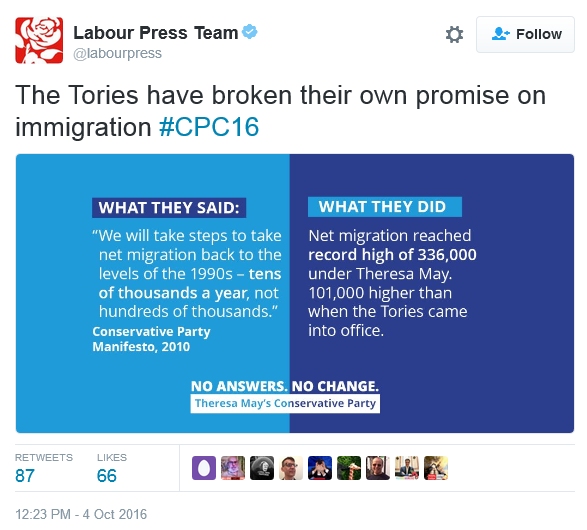
The extremists are winning, and they’re winning because the counter argument isn’t being put.  It’s bad enough seeing the Tories pandering to this sort of nonsense, but Labour have been no better.  Instead of explaining why the Tories are wrong, they merely criticise the Tories (as this from their press office demonstrates) for not doing enough to reduce immigration, thereby reinforcing the basic message.
Whilst for many of us it might seem that the economy isn’t working terribly well at present, it’s doing better than a lot of others.  The UK Government are keen to remind us of that on a regular basis.  But here’s the thing; the more successful any economy is, the more it will draw people in – indeed, the more it will probably need to draw people in.  And a truly successful economy needs to plan adequate services and facilities for the people it employs.  What sort of country is it that draws people in to meet its needs, makes no plans to provide services for those people, and then blames them for the failures and inadequacies of those services?
The people who run the country and the economy are scapegoating immigrants and foreigners for their own failures.  And they’re getting away with it, at least partly because those who understand where the blame really lies are becoming increasingly fearful of the political consequences of breaking the anti-immigration consensus and speaking out.  And that frightens me too – drawing up lists of foreigners is one small step; creating a fear of opposing such ideas is another.    
Europe has seen this sort of thing before – things happen in small steps and people accept them as a result.  It never turns out well.  I’m not the first to worry about that parallel (this video has already been widely shared); although I accept that there’s a danger of exaggeration, and falling foul of Godwin’s Law.  However, if history teaches us anything, it is that exaggerating the danger is better than downplaying it until it’s too late.
I don’t consider freedom of movement as some vague liberal notion, nor as a ‘price we have to pay’ in exchange for selling our cars or sausages on the mainland.  I start from the standpoint of seeing it as a basic human right.  The role of governments shouldn’t be to stop people moving as they wish – it should be to distribute the earth’s resources and wealth more fairly, and to protect human rights and freedoms.  Only when people can see good prospects without having to move will they be able to make a reasoned and rational choice to build a future in their country of origin if that's what they want.  Only life-chance equality will make countries equally attractive as places where people can build the future they want.  Mass migration is a direct result of inequality, of a flow of wealth over generations to the rich and away from the poor.  But who, amongst our politicians, is making that point?

Friday, 18 December 2015

Outraged - but at what?

Two Tory AMs have taken to the media today to express their outrage at the level of redundancy payments being made by Welsh public bodies.  Given that this follows a report by an Assembly Committee, I can understand why the Committee Chair was given such prominence; what was less obvious to me is why the only other AM quoted was another Tory who isn’t even a member of the committee concerned.  There are eight members of the committee, only two of whom are Tories.  Have the others lost their tongues, or could this just possibly be a bit of deliberate selection by the Western Mail?
What the report left me less than clear about is what exactly the AMs concerned – all of them, not just the Tories – think should change here.  Drawing attention to apparently large figures to attract headlines is easy.  Encouraging others to feel equally outraged is equally easy.  But what is the actual problem, and what solution are they offering?
Presumably, the arrangements for voluntary redundancy were freely negotiated between staff and employees – are the AMs arguing that the Welsh Government, or the Assembly through legislation, should interfere with or in some way constrain the rights of either or both parties to negotiate such a scheme?
The report particularly focuses on the payments being made to higher paid staff, but any scheme which bases the size of redundancy payments on salary and length of service will inevitably favour higher-paid staff.  Are the AMs suggesting that long-serving higher-paid staff should be excluded from the schemes, or made subject to some other, less generous scheme?
Maybe they’re suggesting that there’s nothing wrong with the schemes, or with the selection of the people for redundancy, but that the way in which the schemes have been applied has been over-generous.
Or perhaps they’re suggesting that the staff concerned should not have been made redundant at all.  They might be right on that, in some cases at least, but that would sit strangely with a position where AMs of all parties are also calling for ‘greater efficiency’ and ‘reduced management overheads’.  I’m sure that some of the same people have also criticised public bodies for keeping senior people on the payroll even after their roles had been abolished, although I can’t immediately trace the press reports from the time.
It looks like just another part of a continued overall assault on the public sector and those who work in it.  That wouldn’t be at all unexpected from the Tories; what is rather less expected is that is that all the other parties who’ve signed up to the report are so keen to join in.
Most organisations find from time to time that their requirements have changed and that there is an impact on the numbers and type of staff employed.  The point of redundancy schemes is that they aim to ease the transition and maintain the goodwill of those affected by change.  Under almost any scheme imaginable, those with the highest salary and the longest service are likely to receive the highest pay-outs.  That is a feature, rather than a flaw, in the process.
I’m no fan of the size of the pay differential between the highest and lowest paid staff in organisations, whether in the public or the private sector.  But merely criticising the numbers of pounds attached to the outcome of processes based on that differential looks like simple headline-chasing rather than addressing the underlying unfairness and inequality.

Wednesday, 24 June 2015

Causes and symptoms

Yesterday’s scenes at Calais following the closure of the Channel Tunnel highlight again the lengths to which people are prepared to go to reach the UK.  But there seems to be an uncritical acceptance by media and politicians alike that there is a distinction to be drawn between ‘genuine’ asylum seekers and ‘economic migrants’ and that we should therefore be showing sympathy to the first group whilst sending the others back.  Effectively, that is saying that it’s somehow OK to send people back to poverty, as long as they’re not being actively persecuted – and that assumption goes largely unchallenged.
Escaping poverty is as valid a reason for migration – from the point of view of the migrants at least – as is escaping persecution or war.  And I’m certain that there are plenty in politics and the media who understand that, but are afraid to say so given the prevailing climate of hostility towards migrants.  It’s a somewhat cowardly position to take, and it means that the underlying problem largely goes unaddressed.
That underlying problem is a very simple one – global inequality, which modern media and communications makes visible in a way which would not have been the case in previous times.  People can see a higher standard of living is attainable elsewhere, and there is nothing at all unnatural or unexpected about them wanting part of it.  And as long as the wealthy parts of the world try to hold on to their wealth rather than see it shared more evenly, we can and should expect increasing levels of what is euphemistically called ‘economic migration’.  We can either move the wealth to the people, or the people will seek to move to the wealth.  Isn’t that the essence of the message about ‘getting on your bike’?  The Tory perspective seems to be that it’s the right thing to do within the UK, but the wrong thing to do if it involves crossing a border.
Trying to stem the flow is simply responding to the symptoms; and attempting to regulate it by only accepting those with qualifications or skills which we need delivers a double blow to those countries from where the migrants come, because not only are we leaving them in poverty, we’re also taking the most skilled and able of their people to meet our needs rather than theirs.
One might think that in Wales of all places, we would understand this only too well.  Whilst Welsh poverty is not on the same scale as the countries from which so many are trying to escape, have we not suffered, for generations, from the export of our most talented young people?  Is that not part of a process which mantains and perpetuates relative Welsh poverty? 
People rail against the unfair distribution of wealth in the UK which causes the problem in Wales, yet seem unable to see that the scenes at Calais are the result of a similar problem writ large on a global scale.  The problem isn’t migration, it’s inequality.  And unless and until we recognise that and address it, desperate people will continue to do desperate things.

Monday, 20 October 2014

Tackling inequality, not immigration

The 19th-century French radical Alexandre Ledru-Rollin probably never said “There go my people. I must find out where they are going, so that I can lead them”.  Many of the best quotes turn out to be less than entirely accurate.  But that doesn’t reduce their value – and in the case of this one it seems a good description of the approach of many contemporary politicians.  The question is not what they believe (even they seem not to know that) but what they think they have to say to get elected.  And in pursuit of that utterly unprincipled aim many of them are prepared to do and say almost anything.
It’s hard to think of a single political issue which better illustrates the point than immigration.  Politicians seem to be falling over themselves to demonstrate that they will be tougher on immigration.  Are they doing it because they believe is right?  I doubt it; it’s more a case of following opinion than of leading at.  But the net effect is to reinforce rather than challenge prejudice.
All of the discussion around immigration seems to start from the perspective that migration is, or should be, a privilege granted only to a few.  And the competition between parties and politicians is about who can keep that number the lowest and set the highest bar for qualification for that privilege.  But what would happen if we stand the principle on its head?  Why not start from the perspective that freedom of movement and residence is not a privilege for a few, but a right for all?  On that basis the the question becomes not to whom the privilege should be granted – which is all the UK’s parties seem able to discuss - but from whom the freedom should be withheld, and on what basis.
There’s a danger of oversimplifying the reasons for migration.  Of course people have different reasons for seeking to move from one country to another, and I wouldn’t want to understate the impact of conflict and famine for instance.  But the one single cause which has the greatest influence on the movement of people is economic inequality; in essence people believe that they can have a better life, a better quality of life, in a country other than their native country.  And responding to that by raising barriers is not only managing the symptoms rather than the cause, it’s also an attempt to embed and perpetuate inequality rather than reduce it.
Freedom of movement as a starting point is hardly populist, although it strikes me that there are plenty of people who, when pressed, believe that they should be free to move and that it’s only other people’s freedom which should be restricted.  But being popular isn’t the same as being honest or principled, and prejudiced opinion can only be changed by challenging it, not by pandering to it.
We live in a world of finite resources.  The world’s population is growing and that population aspires to the living standards of the richest.  There are two possible policy responses to this – the first is to accept that resources need to be shared more fairly, and the second is to create fortresses to protect the haves from the have nots.  Much of the debate about immigration owes more to that second policy position than the first.  But only the first is tenable in the long term.  It is delusional to believe that current levels of inequality can be sustained for the indefinite future, and even more so to believe that it can be sustained by building barriers.

Monday, 12 May 2014

Symptoms and causes

From many years of canvassing door to door, I’m only too well aware that ‘immigration’ is one of the topics most often mentioned.  It’s always mentioned in a negative light – rightly or wrongly, people perceive it as a problem.  And that seems to be true even in areas where the immigrant population is so small as to be almost undetectable; so whatever the ‘problem’ is, it’s very often not based on any direct or personal experience.  It’s no surprise that politicians want to be able to say something in response – particularly when there’s at least one party campaigning largely on the back of this general unease.
Almost all the work which has been done on the subject of the economic consequences of immigration suggests a net economic benefit rather than disbenefit (quite apart from the fact that parts of the NHS would collapse without the input of migrant workers).  Yet still people believe (or claim to believe) that immigration is a huge economic threat, and politicians vie with each other to pander to that view.  It would be easy to blame the hysteria of some of the tabloids, or even the spinelessness of politicians who know the truth but are afraid of losing votes by articulating it.  Whilst I’m sure that both of those are factors, I suspect that they are only reinforcing a deeper mistrust and wariness of ‘otherness’ rather than actually causing it.
The ‘rules’ surrounding debate of the subject are complex and usually implicit rather than openly stated, which makes it harder to discuss sensibly whether, and to what extent, free movement of people is a problem or not.  All ‘internal’ migration within a state (for instance from England to Wales, or from London to the Lake District) is a no-go area when it comes to discussion, despite the fact that the only real difference between ‘internal migration’ and ‘immigration’ is the constitutional status of the artificial lines on a map which people cross.  And all discussion seems to start from an assumption that movement of people across some lines is something which needs to be ‘controlled’; the only question for debate is how, and at what level.
One of the approaches to control suggested recently was the idea of ‘targetted’ recruitment of immigrants; i.e. identifying what skills are needed and then going out to specifically target people in other countries who have those skills.  It’s a neat answer for politicians to give to those who rail against immigration on the doorstep.  Active encouragement of selective migration (with the implicit suggestion that ‘non-targetted’ immigration would be controlled) is a way of controlling the free movement of people without saying so.  But it leaves me more than a little uneasy. 
If those skills are needed here, are they not also needed in the ‘home’ countries of those possessing them?  Indeed, in many cases they may well be in even more short supply there than they are here.  Whilst attracting people from elsewhere to fill the gaps left by our own inadequate training and education might appear to ‘solve’ our problems (as well as achieving its other intended objective of convincing voters that those advocating such a policy are being ‘tough’ on other immigration), is there not at least a danger that we merely move the skills shortage elsewhere? 
Insofar as there are economic disadvantages to human migration, they’re more lilkely to be suffered by the country from which people are emigrating than the one to which they are immigrating. One of my themes on this blog has been the idea of Wales as a good world citizen; is deliberately planning to take highly skilled and educated people away from where they are even more needed really compatible with that? 
Most migration – to use the wider term – is economic in one way or another, and it happens because people see that they can enjoy a better life elsewhere.  And the cause of that is economic inequality between the richer parts of the world and the poorer ones.  Rather than concentrating on preventing or limiting the movement of people – which is little more than a symptom of economic inequality – might it not be better to turn our attention to how we address that inequality instead of perpetuating it?

Friday, 14 February 2014

Perception and reality

In his latest contribution to the question of the constitutional future of the UK, Labour’s shadow Secretary of State, Owen Smith, talked of the Union as a way to ‘pool risk and share rewards’.  I’ve long thought that, in pragmatic economic terms, that is potentially one of the strongest arguments for union (at any level).
There is a problem, however, in moving from the theoretical to the practical.  The argument falls down as soon as those at whom it is aimed start to feel that they are getting less than their fair share of the rewards and more than their fair share of the risks.  When that point is reached, the argument neatly inverts; the very lack of fairness in a union becomes an argument against it.
Now, as things currently stand, it is pretty clear to me that those of us who believe both that risk and rewards are currently being shared unequally, and that that situation is unlikely to change, are in a minority.  I may believe – and I know that I’m not alone in this – that the majority viewpoint flies in the face of all the empirical evidence, but for whatever reason, the majority still seem to believe either that the peripheral nations and regions of the UK are getting a fair deal, or else that the best way to address the unfairness is to maintain the union. 
Actually, I suspect that it is the second of those two beliefs which is the stronger; I find it hard to conclude that people really cannot see and feel the unfairness which they are experiencing, and if that is so, it must mean that they believe that it is more likely to be addressed within the UK than in some other arrangement.
The obvious question that follows is why people can see the unfairness in the way risks and rewards are shared, and still believe that carrying on as we are is the best way to resolve that.  Two reasons in particular strike me as having some resonance.
The first is that the unfair shares of risk and reward aren’t solely – or even primarily – geographical.  They are also to do with the increasing concentration of wealth in the hands of the few.  Those few may happen to be largely concentrated in one corner of the UK, but they aren’t exclusively so, and it is their personal control of the wealth, rather then their mere location, which is the more important factor.
And the second is that there is still a UK-wide party which is perceived to be supportive of a degree of redistribution.  For some of us, this too may fly in the face of the empirical evidence – after all, the concentration of wealth, in both personal and geographical terms, happened just as much under Labour as it has under the Tories.  It is, nevertheless, a perception which persists, and statements such as those made by Smith last week serve to reinforce that perception.
That ultimately underlines the real disservice which Labour performs - giving the impression that they’re in favour of fairer sharing of risk and reward in order to get into government, and then presiding over growth in inequality when in government.  When will people see through it?

Tuesday, 4 February 2014

Using stealth to avoid tax

“Highly paid people oppose extra tax for highly paid people” isn’t exactly what I’d call news, but given the dominance of highly paid people amongst those who make news and define it, the prominence given to Labour’s pledge to reinstate the 50p tax rate is hardly unpredictable.
There are two elements to the criticism however which strike me as valid - up to a point anyway.
The first is that the amount raised by the extra 5p would be small, partly because the number of people affected is small, and partly because they will find ways of avoiding it, using the convoluted rules of the UK tax code.  All that is true, but surely the best approach to tax avoidance is to prevent it, not to allow it to constrain taxation policy, which seems to be the Tory position. 
And anyway, since when did the fact that a given tax raises only a small amount become a bar to it as a source of taxation?  As we’ve seen in the debate over devolving tax powers to the assembly, there are a range of taxes which raise miniscule amounts when compared to total government expenditure – but that is not in itself adequate reason to abolish them.
The second apparently valid criticism is that the proposal has more to do with politics than economics.  Well, yes – but so what?  The proposal has come from a political party seeking votes.  Given that their economic policies are virtually identical to those of the government, it’s inevitable that they will be looking for a bit of gimmickry to try and present themselves as being in some way different.
But if those two criticisms have some validity, what about the more central claim that taxing the 1% of the population a little more heavily will result in some sort of mass exodus of entrepreneurial talent from these shores? The evidence in support of that proposition is scant.  A few vague threats and a couple of anecdotal examples – but there will always be some who choose to go elsewhere, whatever the tax rates.  Three points in particular strike me as pertinent here:
·         Even at current tax rates, there are other countries and economies with lower tax rates.  If tax rates, or small differences between them, were the main determinant, wouldn’t we be seeing more of a flow in the direction of those countries?
·         Most entrepreneurs, even fairly successful ones, earn less than the £150,000 at which the proposed tax rate would apply.  Some might well aspire to cross that boundary, but by number, most new and developing companies are small to middling.
·         Many, probably most, of those earning over £150,000 aren’t “entrepreneurs” at all.  That target group will include bankers of the speculative kind, and chief executives and senior managers, as well as a not insignificant number of people in the public sector.  Whilst the worst of the bankers, certainly, could take their questionable activities elsewhere, the mobility of many of the rest is limited by factors which have nothing to do with taxation.
It is not through ignorance of the facts that the opponents of Labour’s proposal deliberately conflate two different things here.  “Entrepreneur” is a nice cuddly concept; it’s easy to persuade people that we want to keep "entrepreneurs".  But glossing over the fact that most of the people affected are not entrepreneurs at all is an attempt to protect wealth, privilege, and rent-seeking by stealth.
It is part of the ideology which capitalism builds around itself that those at the top are somehow special and unique rather than merely lucky; they are to be revered and rewarded for their talents, even as they suck our wealth into their hands.  The biggest problem that I have with Labour’s proposal is that it doesn’t really challenge that ideology at all.

Thursday, 7 November 2013

Symptoms and causes

When he says that low levels of attainment in education are linked to levels of poverty, I cannot but agree with the Education Minister.  It’s also impossible to deny the evidence that that is truer in Wales than in England, at least insofar as a simplistic definition of poverty in terms of receiving free school meals is accepted.  Nor can I disagree with his assertion that something needs to be done about all of this.
I’m left concerned though at the nature of his response, which is about ‘breaking the link between poverty and attainment’.  At first sight, it seems to be an obvious response, but it ignores the reality of the long-term failure which is staring us in the face.  It is, at best, an attempt to treat the symptoms, not the disease.
There’s nothing new about the link between social background and attainment.  It’s been studied and reported on for at least half a century.  For at least half a century, politicians have been talking about breaking the link.  And for at least half a century, they have singularly failed to do so.  Yet today’s politicians still seem to be supremely confident that they can achieve something which has defeated others for at least five decades.
It is, of course, much easier to talk about breaking the link than it is to talk about addressing the underlying causes.  And given the average life span of a minister, it’s a pretty safe assumption that it will become someone else’s problem in a few years’ time.  None of that stands up as much of an excuse, though.
The first simple fact is that, if social background is one of the main determinants of attainment, then improving attainment depends on reducing those differences in social background.  And the second is that there is no way of doing that without addressing inequality.  There was a time when one might have expected an understanding of that from a Labour politician.

Wednesday, 16 October 2013

Am I really a mass murderer?

Just a few days ago I referred to the politicians’ trick of presenting only two alternatives and trying to force us to choose between them as though there were no other way forward.  It’s probably a trick learnt from Sir Humphrey.  As if to illustrate the point, the Minister for Agriculture in England came out with a classic this week.
According to Owen Paterson the only options available to us are either that we adopt GM rice on a widespread basis or else millions of people die from vitamin A deficiency.  As if that weren’t enough, he went on to say that anyone opposing GM is thus a “wicked” person who is directly responsible for those avoidable deaths.
It’s a breath-taking piece of hyperbole – almost as if he set out with the intention of discrediting his own arguments.  But no; he is – apparently – entirely serious.
There shouldn’t be any need to point out the basic fallacy, which is that most of us get enough vitamin A from a varied diet and don’t need GM rice.  If people are not getting enough from their diet because they are over-dependent on a single crop, then the problem is that over-dependence - and the solution is to remove the over-dependence, not to tinker with the rice.
The problem with that solution – from his perspective at least – is that the “wicked” people condemning millions to die would then be seen not as the opponents of GM, but as the supporters of a fundamentally unjust and unequal world order.  People rather like Owen Paterson, in effect.
I’m not a fan of GM foods, it’s true.  But my opposition isn’t based on the question of the safety of eating them – the only concern generally recognised by GM fans.  It’s based rather on a belief that we don’t yet know the long-term effects of releasing organisms with exotic gene combinations – which if they ever could develop through evolution or selective breeding would take many generations – into the environment.  That other species will adapt is a given; how and how quickly is one of Rumsfeld’s “known unknowns”.
Supporters of GM always point to the advantages for the poor and hungry in support of their position – although I don’t think I’ve heard one claim, effectively, that anyone disagreeing with is a mass murderer.  Not until this week anyway.  But the main beneficiaries to date have been, and are likely to continue to be, the huge multinational agri-chemical businesses which produce them, not those who grow and consume them. 
In short, it’s the rich who gain most of all.  If it really were the only way of lifting people out of hunger and poverty, it might be a risk worth taking; and it might even be worth accepting that the companies concerned could keep their profits.  But that’s a mighty big – and wholly unsubstantiated – if.

Thursday, 12 September 2013

Equal and fair are not the same thing

The issue of sharing out government spending fairly, on whatever subject area, is neither simple nor straightforward.  Fair shares are not the same as equal shares – if needs were equally distributed life might be a lot simpler.
Unequal shares are easier to identify and highlight than unfair shares; and putting numbers on the inequality makes a nice headline, which is why politicians are so fond of them.
Take this total non-story from yesterday’s Western Mail.  The Tories have been aided and abetted by the Western Mail in highlighting the unevenness of the distribution of grants for sporting activity across Wales.  But nowhere does the non-story even ask the question about whether this is fair or not.  Inequality is effectively deemed to imply unfairness. 
How far should we take this approach?  If every county in Wales received the exact same amount of money per head of population, I rather suspect that we would then have 22 Freedom of Information requests about the distribution within those counties.  They would show that some villages or towns get more than others – and some politician (choose whichever party you like here) would express his or her shock and horror.
Treating equality of expenditure as though it’s the same as fairness would mean – and I’ll admit that this is a case of “reductio ad absurdam” - that the government could just give us £11.23 – or whatever the right figure is – each and be done with it.
I don’t know whether the distribution of sports grants actually reflects the distribution of need across Wales.  And this non-story does nothing to enlighten me.  What I do know is that “need” is not evenly distributed.  I’d be far more suspicious about the fairness of an entirely even pattern than I am about an uneven one.